


Munich Airport
- Organisation Type:
- 30 Million +
- ICAO:
- EDDM
- IATA:
- MUC
- Website:
- http://www.munich-airport.de
- Telephone:
- +49 (0) 89 975 33501
- Country:
- Germany
Status update: “has updated their Cargo page within their profile”
Facts (Overview)
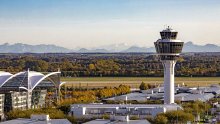
With more than 37.76 million passengers in 2011, Munich Airport has established itself as the business gateway to Europe and ranks number six among Europe's "Top 10" airports. Home of both the Star Alliance in Terminal 2 and the One World and Sky Team in Terminal 1. Munich's traffic strategy to cover all market segments is proving to be successful. The third runway and a new satellite opposite Terminal 2 will secure the long-term development of the airport in line with demand. Welcome to Munich Airport!
Figures
- Number of Terminals:
- Urban population:
- Total Catchment Population:
- Number of Runways:
- Length of main runway (m):
- Operational Opening Hours:
- Ownership:
- Number of Direct Destinations:
- List of Top 5 airlines:
- Passenger Numbers (mppa):
- Cargo Tonnes (p.a.):
- Number of Serving Airlines:
- Aircraft Parking Stands:
-
Contacts
-
Alexander Schroll
Director Traffic Development
-
Christina Werkstetter
Director Traffic Development
-
Oliver Dersch
Director Traffic Development
name
-
-
Awards
-
-
Events
Statement by Dr. Michael Kerkloh, CEO of Munich Airport, at the Munich Press Club.
Ladies and gentlemen, Thank you for the kind introduction. I'd also like to begin by extending a cordial welcome to our press conference here at the center of Munich.
When I presented the 2009 half-year results of our airport at this point last year, I had to announce a 9 percent decline in passenger traffic caused by the global economic crisis. In the end, the full-year results at the end of 2009 still showed a 5 percent decrease in total passengers. I am therefore delighted to report to you today that, after the first six months of 2010, we can say that the negative trend is clearly at an end, and Munich Airport is again posting dynamic gains.
The total passenger volume in the first half of 2010 was close to 16 million, a gain of approximately 3 percent over the previous year's level. With this increase, our airport has significantly outperformed the nation-wide trend. Average growth across all other German airports was just 1.5 percent. The noticeable rise in passenger demand is an even greater achievement when we bear in mind that we faced a number of negative effects during the first half of the year that substantially impacted our traffic figures. It started with the unusually long, snowy winter, with the associated traffic delays, continued with the serious effects of the Lufthansa pilot strike, and culminated in the cloud of ash caused by the volcanic eruption in Iceland, which alone led to 6,500 flights being cancelled. Without these extraordinary events, the increase in passenger traffic at Munich Airport would have been twice as large.
If we follow the traffic figures over the past three quarters, we can state - special effects aside - that we have experienced a steady upward trend that peaked last month, at least for the time being. The 3.2 million passengers using our airport in June 2010 not only represented a double-digit increase of 12 percent, but also set a new record for the month of June in Munich.
In the cargo segment at Munich Airport we saw even stronger gains than in total passengers. With a total freight volume of 127,000 tons, we achieved a 27 percent increase in the first six months over the previous year. This pleasing trend in airfreight is a clear indicator that a broad-based economic recovery is now underway. Naturally our airfreight segment is also benefiting from the further expansion of our hub operations and in particular the growth in the intercontinental traffic segment. Approximately three-quarters of all airfreight flown to or from Munich is carried as co-loaded freight on long-haul routes.
For the current summer timetable period, airlines have opened up six important new long-haul routes at Munich Airport. Lufthansa has added Miami, Riad and Tashkent to its Munich flight schedule, and Lufthansa's Star Alliance partners Singapore Airlines, Continental Airlines and All Nippon Airways have launched services to Singapore, New York and Tokyo. Along with attractive new travel options for passengers, all of these new long-haul connections offer additional capacity for the transport of goods.
Although we can again report strong growth in passenger and freight figures, the current half-year results still show decreases in the area of flight operations. The 185,000 take-offs and landings in the first six months of this year represent a drop of 5.7 percent as compared with the same period of lastyear. The fact that more passengers and cargo were carried on a smaller number of flights can be explained by the trend toward larger aircraft in Munich that continued into the first half of 2010. The planes operated on Munich routes during this period had an average of eight seats more than in the previous year, and also showed improved capacity utilization, with the average load factor up from 69 to 71 percent.
With the transition to larger aircraft and the reduction in flight frequencies, the airlines have attempted to improve their own efficiency during the crisis, but have also responded to the scarcity of slots at airports. An airline that is unable to obtain additional slots during peak traffic periods can now increase its passenger capacity at Munich Airport only by operating larger planes. In our traffic figures, this form of capacity expansion results in a temporary mismatch between the trends in passenger traffic and aircraft movements, as we see in our half-year figures.
Nevertheless, it's now beginning to look more and more as if we can look forward to gains in take-offs and landings as well in the future. In the busy month of June that I mentioned earlier, we can already see the turnaround in this area, with a 2 percent increase in take-offs and landings as compared with June 2009.
All in all, the half-year results provide clear evidence that the aviation sector, like the economy as a whole, has overcome the turbulence and is back on course for growth. At the airport we are now clearly seeing that the upward trend has returned. We are experiencing it in the passenger and freight segments, but also in our parking facilities, shops and the airport's bars and restaurants. In view of the strong improvement in the demand picture, we are now also expecting to see a substantially improved full-year result: I am confidentthat we will hurdle past the 34 million mark in total passenger traffic.
The dynamic traffic growth at Munich Airport is an important driving force for the economy and employment in Bavaria. As an international hub with regularly scheduled connections to 210 destinations in 65 countries, the airport gives our domestic economy fast and convenient access to key markets and major urban centers around the world. However, the economic impetus delivered by the airport is not limited to its role as an asset in the transportation infrastructure. The airport operations themselves also make a significant contribution to employment and value creation at this location.
The total workforce at the nearly 550 companies and public-sector employers at the airport has now reached approximately 30,000. This is one of the principal results of our most recent workplace survey, which we conducted on the basis of figures valid on December 31, 2009. Compared with the previous survey from 2006, the number of employees increased from 27,400 to 29,560. This represents a gain of 2,160 new jobs, or an increase of some 8 percent. In other words: over the past three and a half years, Munich Airport has generated an average of two new jobs every day. The global financial and economic crisis, which led to a decrease in passenger traffic at Munich Airport for the first time in six years in 2009, did not cause a decline in available employment at the airport. As we were able to gather from the responses of the employers, most companies maintained a constant workforce during the year of crisis in 2009.
The biggest employers at Munich Airport are the Lufthansa Group and the FMG group of companies, with 9,200 and 7,700 employees, respectively. Lufthansa inparticular has substantially increased its workforce in Munich in recent years with the development of its hub traffic here, and has thus been the main driving force behind the positive employment trend. With regard to the communities where our employees live, the available data show strong increases particularly in the airport districts of Freising and Erding as well as the city of Munich. More than 6,100 airport employees live in the district of Freising - an increase of about 600, or 11 percent, as compared with the previous survey. In the city of Munich the figure is now 5,800: a gain of nearly 500, or 9 percent, since 2006. The district of Erding is home to about 4,800 airport employees. This figure shows a rise of 300, or 7 percent, since the survey three years ago.
The wages and salaries of airport employees have also risen significantly. The new survey reports that the average annual gross salary of the workforce has now topped the 37,000 euro mark, despite the inclusion of all part-time and casual staff. By comparison: At the time of the 2006 survey, the corresponding amount was just 32,000 euros. The decisive factors behind the sharp rise in the average salary probably includes the above-average increase in the proportion of certain highly skilled occupations such as flight deck crews. Conversely, the number of casual staff working at Munich Airport has fallen substantially as compared with the national and Bavarian averages: this segment of the workforce has decreased in the meantime to just 5 percent of the Munich Airport workforce. By comparison: In Bavaria as a whole, 14 percent of all employees are employed on a casual basis in so-called 400 euro jobs, and 15 percent across Germany.
On an annual basis, the wages and salaries paid out at the airport add up to a whopping 1.1 billion euros. By comparison: in 2006, the total was just 876 millioneuros. That means that the total of all wages and salaries has grown by 25 percent - and along with it, the resulting purchasing power as well as the income tax base of the cities and municipalities.
Another figure revealed by the survey is also indicative of the high quality of the jobs at Munich Airport: 19,000 airport employees - 10 percent more than in 2006 - were found to be in full-time employment with social insurance coverage. When the part-time employees with this status are included, the share of airport staff working in jobs with social insurance coverage has now reached 85 percent. By comparison: Both in Germany as a whole and in Bavaria, employees covered under social insurance schemes make up only 68 percent of all persons in paid employment.
Incidentally, in the region covered by the Freising/Erding Employment Office, the number of jobs with social insurance coverage is now just over 100,000. That means that every fourth socially insured employee in this agency district is working on the airport campus. Munich Airport also remains a reliable asset for its neighbors as the region's largest provider of occupational training opportunities. On the reporting date of the survey, 652 trainees and apprentices were receiving training in 35 different occupations at Munich Airport. This represents a further 5 percent increase in such positions since the last survey. By the way, the largest employer of young people preparing for future careers is the FMG Group, which now has 250 trainees and apprentices under contract, almost all of whom are residents of the airport region.
Ladies and gentlemen,
A noticeable upswing in traffic statistics and an impressive affirmation of Munich Airport's role as a job-generating machine - these are the two key messages in the figures presented here today. We want to use the opportunities that these positive trends present to Munich Airport and the state of Bavaria as a whole. As the latest traffic forecasts indicate, passenger traffic at Munich Airport will continue to increase in the coming years and in 2025 will reach a level in the order of magnitude of 58 million. This additional traffic volume will secure the jobs at the airport while bringing about the conditions for thousands of new jobs to be created there.
For the success story of our airport to continue, we will have to be willing and able to cope with the rising demand for air transportation through capacity expansion measures geared to these needs. As you know, we began years ago with the planning for a third runway and a satellite facility for Terminal 2, and are now making good progress with both projects. As for the third runway, the ongoing planning approval process is now headed into the final stretch. With regard to the satellite, we have since completed the design drawings. Now we are taking the final steps to set the stage for the realization of this project.
In the World Airport Awards 2010 announced by the London-based Skytrax Institute, our Munich Airport was voted Europe's best airport and the fourth-best airport in the world in a survey of 10 million passengers. We will make every effort to retain these excellent rankings in the coming years. The strategic expansion measures we are pursuing are the key to success in these efforts because they will put us in a position to offer our passengers at Munich Airport increasingly attractive destinations while maintaining the same outstanding standards for service and amenities. In view of Munich's possible selection to host the 2018 Winter Olympics, this is definitely a worthwhile goal, which will continueto motivate our airport team, now with the 30,000 members, to deliver excellent performance.
- Posted 13/07/2010
- Upcoming Key Routes
- 0
- Underserved Key Routes
- 0
- Unserved Key Routes
- 16