
-
Opening Remarks
Hear more about why Routes Asia 2026 is taking place in Xi'an, China
*By invitation only
This site is operated by a business or businesses owned by Informa PLC and all copyright resides with them. Informa PLC's registered office is 5 Howick Place, London SW1P 1WG. Registered in England and Wales. Number 8860726.
Routes is part of the Informa Markets Division of Informa PLC


Routes Asia 2026
Xi'an, China
• 14 – 16 April 2026
The Routes Asia conference programme will bring together senior leaders from the air service development and aviation industries.
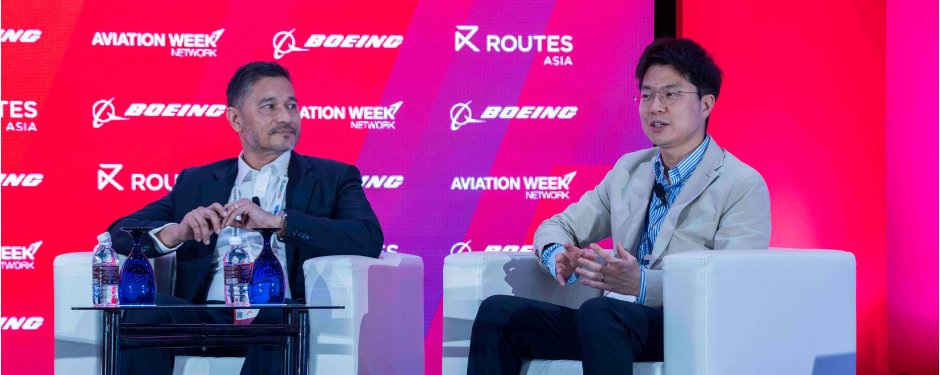
Comprising keynote interviews, panel discussions, airline briefings and best practice workshops, the Routes Asia 2026 conference programme will provide you with exclusive insight into the key air service development issues driving change within the industry, exploring the future of air service development in the region.

Platinum Conference Sponsor

Platinum Conference Sponsor
Hear more about why Routes Asia 2026 is taking place in Xi'an, China
*By invitation only
Welcome introduction from Routes. Hear what you can expect over the course of the event.
*By invitation only
Stefano Baronci, Director General, Airports Council International (ACI) Asia-Pacific & Middle East
Passenger traffic across Asia-Pacific is forecast to grow 4.8% annually between 2025 and 2028, driven by resilient economies, renewed international demand, and record levels of airport investment.
India and Vietnam are leading the region’s momentum, with Southern Asia already surpassing pre-pandemic passenger volumes, while Eastern Asia’s recovery is accelerating on the back of China’s outbound rebound. Despite ongoing aircraft delivery delays and geopolitical uncertainties, most markets are expected to exceed pre-COVID levels by 2026.
This session will highlight key trends, including infrastructure investment, sustainability efforts, and evolving passenger expectations, positioning the region as a global aviation leader.
From the war in Iran to ongoing airspace restrictions over Russia, geopolitical disruption continues to reshape global aviation flows. The closure of key Middle East corridors and the suspension or reduction of services by Gulf carriers have removed critical one-stop connectivity between East and West, forcing airlines to rapidly rethink network strategies. This session will explore how airlines and airports are responding in real time—rerouting traffic via longer northern and southern corridors, shifting connecting flows to alternative hubs such as Istanbul and Southeast Asia, and adapting schedules amid heightened operational risk. It will also examine the impact of volatile fuel prices, airspace complexity and shifting passenger confidence on capacity planning and route viability.
Effective partnerships between airlines, airports and tourism bodies are fundamental to successful route development. This panel brings together industry leaders to discuss how collaboration can translate into sustainable growth, not just short-term gains.
Speakers will explore current best practice, including data-led decision-making, joint marketing activity and incentive models that genuinely support long-term routes. The discussion will also look beyond the traditional airline-airport-destination relationship, considering the influence of governments, investors and other stakeholders in shaping viable route opportunities.
*By invitation only
Advances in aircraft technology are reshaping the economics of route development. New-generation narrowbodies, including longer-range and more fuel-efficient variants, are enabling airlines to open routes that were previously unviable—linking secondary cities, bypassing traditional hubs and supporting more point-to-point connectivity across Asia and beyond. This session will explore how airlines are deploying these aircraft to unlock new markets, increase frequency on thinner routes and respond more flexibly to shifting demand. It will also examine how airports and destinations can position themselves to capture these opportunities.
VietJet's Vision for Growth and Fleet Expansion
As Asia-Pacific moves beyond recovery, the focus is shifting from rebuilding networks to making sharper, more strategic choices about where—and how—to grow.
This session will examine how airlines are prioritising capacity across the region, from high-growth markets such as India and Southeast Asia to the more measured recovery in North Asia. Rather than chasing scale, carriers are increasingly focused on yield, resilience and network optimisation—resulting in more selective route launches and a greater emphasis on sustainable performance.
The panel will explore where airlines see the strongest opportunities over the next five years, how they are balancing risk and return, and what this means for airports competing for capacity. It will also consider how evolving demand patterns, competitive dynamics and structural constraints are reshaping the region’s connectivity map.
India’s aviation market is undergoing rapid expansion, with dual-airport systems emerging as a pivotal solution to address capacity challenges and drive future growth. New Delhi is leading the charge with the development of Noida International Airport, while Mumbai is advancing with Navi Mumbai International Airport, positioning India as a global leader in aviation infrastructure.
In this fireside chat, Edmond Rose and Arun Bansal will discuss:
Join us for an engaging conversation on how dual-airport systems are reshaping India’s aviation landscape.
China is once again a central force in global aviation, with long-term growth projections pointing to one of the world’s largest and fastest-evolving air travel markets. This session will explore how Chinese and international airlines are responding to a complex operating environment defined by geopolitics, airspace constraints, fleet availability and shifting demand patterns.
With China forecast to require thousands of new aircraft over the next two decades—driven largely by domestic and regional growth—the discussion will examine how capacity is being deployed and where the next opportunities lie.
The panel will also assess China’s airport development strategy, including the “3+7+N” framework, which is reshaping the country’s connectivity model by strengthening major global gateways while accelerating the rise of regional hubs and secondary cities.
In addition, speakers will consider the role of policy—from visa facilitation to transit schemes and inbound tourism initiatives—and whether recent liberalisation measures are translating into meaningful international traffic growth.
*By invitation only
Exclusive updates direct from key airline decision makers and network planners.
* Please note like all events, the programme is subject to change.
 Stefano Baronci
 Arnaud Maheu
Chen Chuanren
Simon Nathan
Arnaud Maheu
Chen Chuanren
Simon Nathan David Casey
 Robert Sham