



Natal Airport Achieves International Carbon Management Certification
https://natal-airport.com/sobre-nat/noticias/102595-aeroporto-de-natal-alcanca-certificacao-internacional-de-gestao-de-carbono
Natal International Airport, located in São Gonçalo do Amarante, has received international recognition for its carbon management practices across airport operations. The airport has become the second in Brazil’s North and Northeast regions and the fifth in the country to achieve Level 4 accreditation under the Airport Carbon Accreditation (ACA) program. Since taking over operations at Natal Airport in 2024, Zurich Airport Brasil has reduced operational carbon emissions by 56%.
In addition to Natal Airport, the airports of Florianópolis, Vitória, and Macaé, also managed by Zurich Airport Brasil, hold Level 4 Airport Carbon Accreditation. Zurich Airport Brasil is the only airport concessionaire in Latin America with 100% of its airports recognized at this level for carbon management.
The accreditation recognizes the progress airports have made in climate management through a structured seven-level program, ranging from Levels 1 to 5. Level 4 demonstrates that an airport continuously monitors its emissions, implements energy-efficiency projects, expands the use of renewable energy, and engages the airport community in reducing emissions from operations.
In practice, ACA Level 4 accreditation demonstrates that the airport has not only achieved consistent reductions in its direct greenhouse gas emissions and strengthened the engagement of partners operating across the airport site, but also has a robust and validated strategy to achieve net-zero emissions by 2040, aligned with the Paris Agreement and the recommendations of the Intergovernmental Panel on Climate Change (IPCC).
To achieve the accreditation, the airport underwent a rigorous international audit and validation process, including independent verification by an accredited body and a technical review by Airports Council International (ACI), which oversees the Airport Carbon Accreditation program.
“This achievement is extremely important to what we strive for across our airports: efficient, sustainable, and outstanding operations. In Natal, this recognition is particularly significant, as Rio Grande do Norte is widely recognized as a green destination, with a strong clean and renewable energy sector, as well as rich ecosystems and biodiversity throughout the state,” said Ricardo Gesse, CEO of Zurich Airport Brasil.
Zurich Airport Brasil took over operations at the airport in 2024 and has since systematically monitored its greenhouse gas (GHG) emissions while implementing initiatives aimed at decarbonizing its operations. As a result, emissions fell from 1,668 tCO₂e in 2024 to 738 tCO₂e in 2025, representing a reduction of approximately 56%. This result was achieved through the use of 100% renewable electricity, the implementation of energy-efficiency measures, and improvements to the airport’s HVAC systems.
“Natal Airport’s Level 4 accreditation reinforces Zurich Airport Brasil’s leadership in sustainability. Having all four airports under its management accredited at this level of Airport Carbon Accreditation is a remarkable achievement and demonstrates a consistent commitment to decarbonization and global climate goals,” said Rafael Echevarne, Director General of ACI-LAC.
Initiatives Supporting the Accreditation
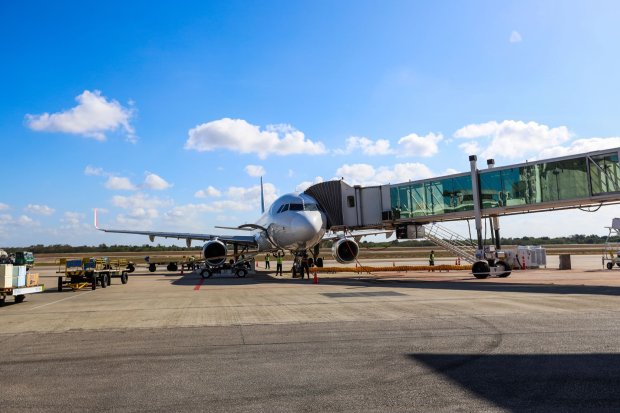
Among Zurich Airport Brasil’s carbon management and emissions-reduction initiatives are the implementation of 400 Hz and PCA (Pre-Conditioned Air) systems, which provide renewable electricity and conditioned air to aircraft while on the ground, eliminating or significantly reducing the need to use fossil fuel-powered Auxiliary Power Units (APUs). The systems became operational in 2025 and are used by all airlines operating at the airport.
Since their implementation in May 2025, the systems have avoided 1,616 tonnes of CO₂e in Scope 3 emissions from airlines, making a significant contribution to reducing emissions across the aviation value chain. This volume of avoided emissions is equivalent to the estimated carbon sequestration potential of approximately 12,400 Atlantic Forest trees, highlighting the initiative’s positive contribution to the transition toward lower-carbon airport operations.
In parallel, Natal Airport is finalizing its photovoltaic solar power plant project, which will make it one of the first airports in Brazil to achieve energy self-sufficiency. The project represents an investment of BRL 24 million, with the plant expected to begin operations by the end of the year, providing the airport with clean and sustainable energy.
About ACI
Airports Council International (ACI) is the global association of airports, representing approximately 2,000 airports in more than 170 countries. In Latin America and the Caribbean, ACI-LAC represents airports responsible for approximately 95% of the region’s air traffic, promoting the sustainable, safe, and efficient development of the airport industry.
ACI Airport Carbon Accreditation is the only global carbon management certification program specifically designed to assess and recognize airports’ carbon management performance.