


Dovetail Electric Aviation – Accelerating Sustainable Aircraft
 Credit: https://dovetail.aero/
Bringing Tomorrow Forward, Today
Introduction
The need for sustainable aviation can no longer be postponed. This urgency is evident in measures such as the French Government’s discussions to limit short-haul flights where rail can serve the route in under 2.5 hours. However, developing and certifying new clean-sheet aircraft can take decades.
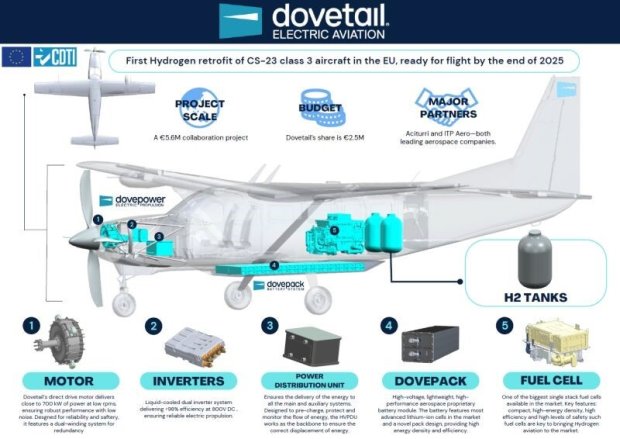
Dovetail Electric Aviation is fast-tracking the introduction of commercially viable, sustainable aircraft by retrofitting existing certified airframes with zero-emission engines. These engines are designed to operate on hydrogen or electricity—two fuels that can be produced at scale.
This pragmatic approach has attracted strategic investment from leading players in Australia and Spain, including Rex Airlines, Sydney Seaplanes, Air Nostrum, Volotea, and Aciturri, a major aeronautical component manufacturer.
Dovetail’s proprietary electric propulsion system (Dovepower) and battery technology (Dovepack) deliver environmental, commercial, and customer benefits. They offer a compelling solution for airlines such as Air France–KLM, helping them meet sustainability targets while expanding network reach and maintaining competitive advantage.
Environmental Benefits
- Noise Reduction – Electric aircraft are significantly quieter than turboprops, enabling operators to negotiate noise-related curfews and improve passenger and freight connectivity.
- Lower Carbon Footprint – When powered by renewable electricity or green hydrogen (e.g., solar, wind, nuclear, or hydro), Dovetail engines can achieve zero emissions. This opens opportunities for routes currently restricted to hydrocarbon aircraft, such as short-haul flights in France.
Commercial Benefits (Financial & Operational)
- Reduced Maintenance Costs – Electric engines have fewer moving parts than conventional engines, resulting in less downtime, improved aircraft utilization, and lower maintenance costs. Dovetail projects a three-year payback compared to traditional engines, with operating cost reductions of up to 40% for regional airlines. This cost efficiency can make previously unviable regional routes economically feasible.
- Fleet Commonality – Dovetail’s powerplant is designed for versatility, capable of powering popular aircraft in the under-20-passenger category, including the Cessna Caravan, Beechcraft King Air, Twin Otter, and Pilatus PC-12. The system showcased in Seville was customized for the King Air, with all components—except the hydrogen tank—integrated within the existing engine nacelle.
Source: https://dovetail.aero/dovetail-electric-aviation-showcases-revolutionary-hydrogen-electric-powerplant-prototype-in-spain/
Customer Benefits
Dovetail’s powerplant enables existing passenger and cargo aircraft under 20 seats to serve regional routes efficiently. For example, it could connect Mediterranean archipelagos to the mainland or open new routes such as Faro to Jerez (173 km), reducing travel time to less than one-third of current alternatives.
In Australia—one of the largest markets for the Cessna Caravan—Dovetail engines have broad applicability across general aviation (skydiving, scenic flights, agricultural, and aeromedical) and regular public transport (RPT). A practical sustainability solution for the Great Barrier Reef could involve Dovetail-powered Cessna C208 Caravans or Beechcraft King Air 200s servicing island resorts like Great Keppel Island or Dunk Island.