


Vehicle-to-Grid (V2G) EV Charging at Airport Car Parks
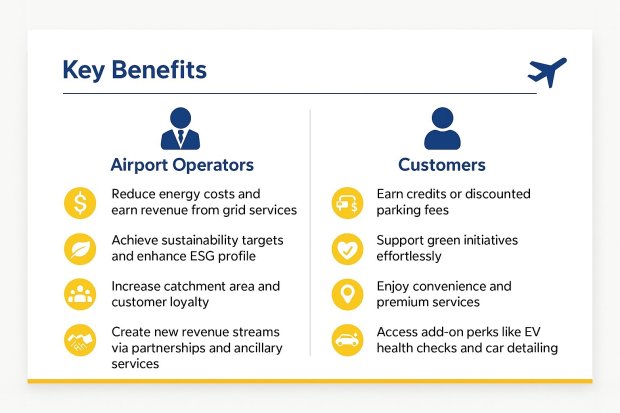
Vehicle to Grid at Airport Car parks provide new revenue streams, reduces operational costs, and supports sustainability goals.
Executive Summary
Vehicle-to-Grid (V2G) technology enables electric vehicles (EVs) parked at airports to supply energy back to the grid. This creates new revenue streams, reduces operational costs, and supports sustainability goals. Airports can leverage V2G to cut costs of achieving net zero compared to alternative/ build from scratch renewable projects, while enhancing customer experience and loyalty. V2G can supplement on site Battery Energy Storage Systems, which cost from $1.2M AUD per MW.
The ability to offer guaranteed charging on car pick up, provides airports the ability to compete with alternative airports, improving its reach and minimizing spill in its catchment area.
Benefits for Airport Operators
- Revenue Opportunities: Monetize parked EVs through avoidance of grid energy usage (>$0.30/kWh) and demand ($6.763/kVA in Brisbane for CAC HV Bus) during peak times.
- Cost Reduction: Lower infrastructure by using customer’s EV battery and energy costs by using in house solar (<$0.08/kWh) compared to purchasing additional batteries on site.
- Competitive Advantage: Differentiate from rival airports and attract more passengers.
- Operational Efficiency: Reduce peak demand costs and diversify energy sources (on and off grid) for backup power, plus freeing up grid to assist the electrification of aircraft and ground handling (and move off gas/ diesel)#
- Sustainability Leadership: Support Scope 3 emissions reduction and carbon-neutral operations.
Benefits for Customers
- Guaranteed Charging: Cars charged to 80–100% for return trips from Airport to home, which is critical for customers requiring long distance driving.
- Lower Parking Costs: Potential to cut valet fees from $100/day to $70/day via V2G credits.
- Additional Income: Earn $100/day by renting out EV during holidays (optional model).
- Premium Services: EV health check, detailing, co-branded loyalty perks, especially where an airline does not operate their own branded valet parking.
- Convenience: Avoid searching for fast chargers after flights.
Case Studies & Proof Points
|
Airport |
Initiative |
Key Benefit |
|
Amsterdam Schiphol |
Smart EV charging and V2G pilot |
Achieved a benefit-to-cost ratio of 3.7 for frequency regulation services^ |
|
Oslo Airport |
Integrated V2G with renewables |
Achieved carbon-neutral operations and ancillary revenue |
|
London Heathrow |
Large-scale EV infrastructure with bidirectional charging |
Enhanced sustainability and customer engagement |
Implementation Path
1. Partner with V2G providers for technology and funding.
2. Learn and collaborate with councils already trialing V2G (E.g. Byron Bay, Waverley in NSW, Australia).
3. Target early adopters (BYD, Nissan Leaf owners) and dealerships.
4. Align with Airport Masterplan sustainability targets.
5. Develop premium co-branded services for frequent flyers.
Footnotes
# Brisbane Airport Corporation. (2025). Preliminary draft 2026 master plan – Chapter 15: Services and utilities (p. 254). Retrieved from https://media.caapp.com.au/pdf/mvUHJm2YXInl/d94be421-f51e-43fd-ac02-518a489f2dd4/Preliminary%20Draft%202026%20Master%20Plan%20-%20Chapter%2015%20-%20Services%20and%20Utilities.pdf The masterplan identified the potential need for 12 MW of battery storage (BESS), which could be halved using 200 EVs with 30kW batteries.
In 2025, a Lithium-ion BESS (1 MW / 1 MWh) would cost between AUD $1.2–$1.6 million (≈ $1,200–$1,600 per kWh), including EPC (Engineering, Procurement, Construction), inverter, and grid connection.
Australian Renewable Energy Agency (ARENA) & Australian Energy Market Operator (AEMO). (2023). Electricity Statement of Opportunities and Battery Storage Cost Trends Report. Retrieved from https://arena.gov.au and https://aemo.com.au
^ Mukherjee, A. (2024). Financial Cost-benefit Analysis of Vehicle-to-Grid charging of Electric Vehicles at Schiphol Airport (Master’s thesis, Delft University of Technology). Retrieved from TU Delft Repository.