


Organisation Type:
30 Million +
ICAO:
EDDM
IATA:
MUC
Website:
http://www.munich-airport.de
Telephone:
+49 (0) 89 975 33501
Country:
Germany

Status update: “has updated their Cargo page within their profile”

Facts (Overview)

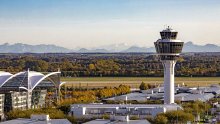
With more than 37.76 million passengers in 2011, Munich Airport has established itself as the business gateway to Europe and ranks number six among Europe's "Top 10" airports. Home of both the Star Alliance in Terminal 2 and the One World and Sky Team in Terminal 1. Munich's traffic strategy to cover all market segments is proving to be successful. The third runway and a new satellite opposite Terminal 2 will secure the long-term development of the airport in line with demand. Welcome to Munich Airport!

Figures

Number of Terminals:
Urban population:
Total Catchment Population:
Number of Runways:
Length of main runway (m):
Operational Opening Hours:
Ownership:
Number of Direct Destinations:
List of Top 5 airlines:
Passenger Numbers (mppa):
Cargo Tonnes (p.a.):
Number of Serving Airlines:
Aircraft Parking Stands:

Munich Airport job machine generating average of two new jobs a day

Total workforce at Munich Airport now numbers approximately 30,000

the global financial and economic crisis, Munich Airport remains a reliable source of employment. The most recent workplace survey by FMG, the Munich Airport operating company, shows that, as of December 31, 2009, the 549 companies and public-sector entities located at the airport had a total workforce of 29,560 employees. This represents 2000 new jobs since the last survey in 2006: a gain of 8 percent. This means that the Munich Airport job-generating machine has cranked out two new jobs a day over the past three and a half years.

The Lufthansa Group - at present the biggest generator of employment at Munich Airport - now has a total staff of 9,200 at its Munich operations, and has succeeded FMG as the airport's biggest employer. FMG, including its subsidiaries, now has a total workforce of about 7,700. Approximately 85 percent of the people working at the airport have positions with social insurance coverage. This figure is significantly higher than average in the state of Bavaria or in Germany as a whole, both of which are below 70 percent.

A key indicator of the airport's economic impact is the income earned by the employees. Total wages and salaries paid to people working at the airport in 2009 amounted to approximately 1.1 billion euros. This means that the purchasing power of the entire workforce, most of which benefits the communities in the immediate vicinity, has again increased by one-quarter since the last survey. Statistically speaking, airport employees earn more than 3 million euros in wages and salaries every day. The annual average salary of airport employees increased from 32,000 euros in 2006 to over 37,000 euros. As a result, the average wages at the airport, including part-time and casual staff, are actually higher than the German national average earnings for full-time positions in the transportation and freight industry.

Most airport employees still make their home in the district of Freising. Since the last survey the number of employees living there has increased by nearly 600 to 6,116 (a rise of 11 percent). The share of the workforce coming from the city of Munich is up by almost 500, or 9 percent, to approximately 5,800 employees. For 4,801 employees the registered place of residence is the district of Erding. This represents an increase of 300 (7 percent) as compared with the last survey. There was little change in the corresponding figures for the town and district of Landshut, which is home to 2,951 members of the Munich Airport workforce.

The majority of jobs at Munich Airport relate to the actual flight operations. A total of over 15,000 employees, or more than half of the airport workforce, are involved in the handling of aircraft, passengers and cargo, catering, flight crews, ticket sales and air traffic control. Guarding and security tasks are playing an ever-increasing role at Munich Airport. The number of employees working in this area has now reached nearly 3,700 - a gain of 12 percent as compared with 2006.

Upcoming Key Routes
0
Underserved Key Routes
0
Unserved Key Routes
16

Airline Opportunities

Data

Last updated: Feb 6, 2012

Facilities

Last updated: Feb 6, 2012

Catchment and Demographics

Last updated: Jan 27, 2012

Pricing and Incentives

Last updated: Jan 18, 2012

Trade

Last updated: Jan 18, 2012

Cargo

Last updated: Feb 6, 2012
Back to Top