



Why Gia Binh (GBN) is built to be Asia's best airport for full-service airlines from 2029
 Credit: Masterise Aviation Infrastructure
Five-star standards, fast connections, room to grow and a premium catchment: why 4- and 5-star airlines should plan their Hanoi future at Gia Binh International Airport.
Full-service airlines choose airports that protect their product: a premium passenger experience, reliable operations, quick connections and a market that pays for quality. Gia Binh International Airport (GBIA – ICAO VVGB, IATA GBN), the new international airport for Hanoi and the Capital Region, is being designed from the ground up for exactly these airlines, as they plan their networks for 2029 and beyond.
Designed for five-star from day one
- A Skytrax five-star target: GBIA is designed to five-star standards, aiming for a place among the world’s top 10 airports.
- An effortless premium journey: a digital passenger experience, a curated mix of retail and dining, frictionless transfers and fast connections to Hanoi and the surrounding destinations.
- World-class design: architecture inspired by Vietnamese culture and the “Heaven, Earth and Humanity” philosophy, developed with daa International, SOM, NACO, Nikken Sekkei and other leading partners, with LEED Gold targeted for the terminals.
Built for full-service operations
- Hanoi’s hub for full-service and long-haul airlines: Gia Binh is planned as the capital region’s international transfer hub, and the Government is studying an operating plan that includes moving all international operations from Noi Bai to Gia Binh.
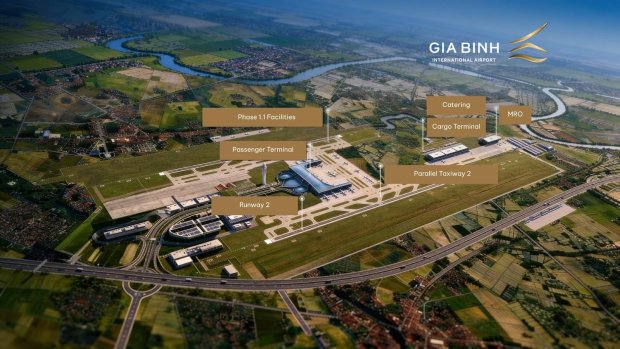
- Efficient and on time: two runways with simultaneous take-offs and landings, 70–80 movements an hour, fast turnarounds and short connection times.
- Capacity when you need it: with capacity ahead of demand, airlines can schedule at the times their networks need.
- Complete support on site: catering, MRO facilities and a fuel farm are part of the passenger terminal phase.
A premium market that is growing fast
- A rising middle class: Vietnam’s economy grew 8.02% in 2025 and 9.01% in January–September 2026, and incomes are targeted to double to about US$20,000 per person by 2045.
- Corporate demand on the doorstep: the Hanoi – Bac Ninh – Hung Yen – Hai Phong corridor attracts 42% of Vietnam’s foreign direct investment, and Bac Ninh became Vietnam’s largest exporting province in 2025, home to major electronics manufacturers such as Samsung.
- Tourism at record levels: 21.2 million international visitors in 2025, with Vietnam targeting 45–50 million a year by 2030.
- Long-haul demand waiting: around 4 million passengers a year travel between Hanoi and Europe or the Americas with no direct flight.
Room to grow with you
- 30 million passengers and 1.6 million tonnes of cargo a year by 2030, 50 million passengers by 2050 and, in the long term, 100 million passengers.
- An aerotropolis around the airport: airport city, free trade zone, industrial parks, conference and leisure facilities, creating more reasons to travel all year round.
- About 25 minutes from central Hanoi once the direct expressway opens at the end of October 2027, with high-speed rail and metro links expected by 2029–2030.
A partner for your launch
Our Air Service Development team offers route launch support, co-marketing, destination marketing with tourism partners, and market insight with a route business case built around each airline’s network.
As things stand, the tentative key dates are: the airport officially opens on 31 May 2027, starting with the VIP terminal, and the commercial passenger terminal follows as a separate phase.
Talk to us
Full-service airlines planning their 2029 networks are invited to contact [email protected].
Sources: National Statistics Office of Vietnam; GBIA planning figures and corporate presentation (October 2026).