



Aircraft Interiors industry development summary: Jan/Feb-2026 - A321XLR lavatory headaches
The arrival of the A321LR and XLR have greatly expanded the possibilities for the A321neo family. With increasingly complex deployments, A321neos worldwide are being configured with ever more varying approaches.
Such a rapid pace of changes is leading to various untested concepts that are only beginning to face real-world guest feedback.
In this regular bi-monthly analysis, CAPA - Centre for Aviation will deep dive on two recent consumer backlashes associated with the A321neo family.
Summary
- A321LR/XLR capability is driving increasingly varied A321neo cabin configurations, some of which are only now being validated by real-world passenger feedback.
- Qantas’ first three A321XLRs entered service with only three lavatories total, leaving economy at a 1:90 lavatory-to-passenger ratio and triggering significant backlash.
- Qantas said the lavatory shortfall is temporary, with later deliveries replacing three economy seats with an added lavatory and retrofits planned for the first three aircraft.
- American Airlines’ A321XLR has four lavatories, but its allocation policy forces premium economy to share the forward lavatory with business, creating heavy front-cabin congestion.
- American Airlines' front-cabin ratio is about 32 seats per lavatory (plus crew), while the rear cabin becomes unusually generous at approximately 41 seats per lavatory.
- ITA Airways and SAS Scandinavian Airlines avoid front-lavatory bottlenecks by directing premium economy to use rear lavatories, and upcoming United and Delta A321neo layouts will be watched for similar issues.
Qantas' Three Odd A321XLRs
When the first Qantas Airways A321XLR entered service in Sep-2025, the event attracted media attention for all the wrong reasons.
All focus was on the lavatory count.
Onboard the first Qantas A321XLR are three lavatories, of which two are reserved for the 180 guests in economy class. This represents a lavatory-to-passenger ratio of 1:90.
There was an avalanche of criticism online.
Qantas quickly had to issue statements on how this was only temporary. Starting from the fourth A321XLR, three economy class seats will be replaced by one additional lavatory. The first thee A321XLR will have a lavatory added at a later date.
Let's put this into context.
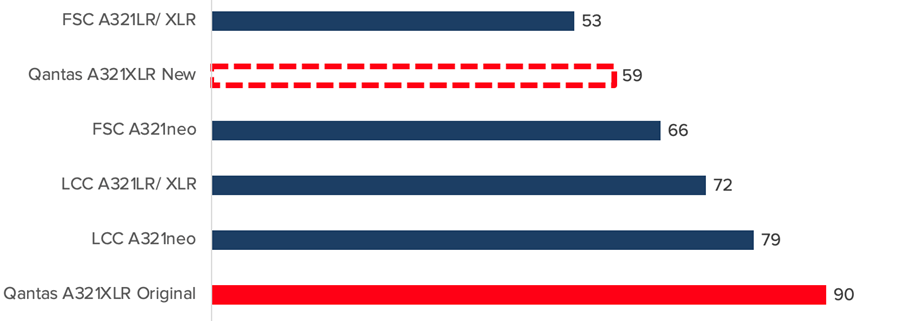
As shown in the graph below, the 1:90 ratio introduced by Qantas is extreme, not only when compared to other full service carriers (FSC) operating the A321neo; it is even worse than the average seen on low-cost carriers (LCC). Only with the new configuration will Qantas' numbers fall better in line with industry peers.
Economy class seats per lavatory on in-service Airbus A321neo operated by scheduled airlines, as of Feb-2026
Source: CAPA - Centre for Aviation Aircraft Interiors Database.
Interestingly, Qantas already foresaw this backlash, but was seemingly too late to reverse course for its initial deliveries.
When Qantas first announced its A321XLR configuration in Aug-2024, the airline curiously marked the number of economy class seats as 177 or 180. At the end of the information page was a footnote: "the first three Qantas A321XLRs will arrive configured with 180 economy seats".
The reason behind the variation wasn't clear then, but we now know why...though it has yet to be disclosed why Qantas came to its original decision in the first place.
American Airlines head-scratching A321XLR lavatory assignment
American Airlines' A321XLRs are also facing guest complaints, but at the pointy end.
American Airlines is one of three airlines globally, besides ITA Airways and SAS, to introduce a separate seat type between business and economy on the A321neo series. In addition to 20 Flagship Suite seats, there are 12 premium economy seats - the latter is more akin to standard narrowbody business class seats.
Differently from Qantas, American Airlines did take delivery of its first A321XLR with four lavatories. The problem is how it chose to assign the lavatories to different cabins.
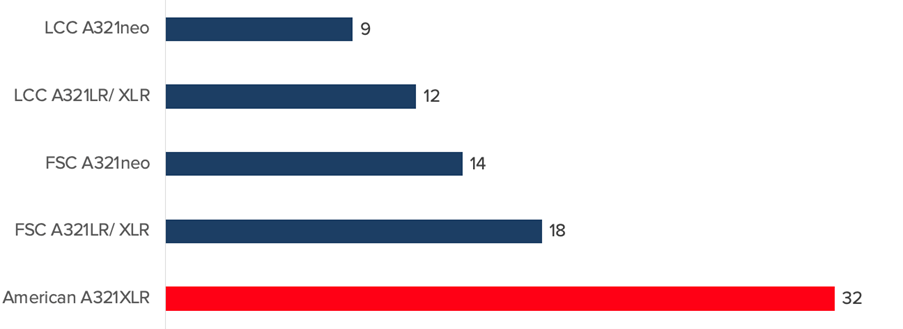
The US major chose to have premium economy passengers use the front lavatory alongside Flagship Suite guests. This means one lavatory shared by 32 guests, a staggering number amongst A321neo operators, as demonstrated in the graph below. The number is even higher when including pilots and front cabin crew.
First and business class seats per lavatory on in-service non-monoclass A321neo operated by scheduled airlines, as of Feb-2026
Source: CAPA - Centre for Aviation Aircraft Interiors Database.
Although American made the front lavatory too crowded, it is now the most generous worldwide in the back cabin, with a seat-to-lavatory ratio of 41:1.
On the contrary, ITA Airways and SAS direct the 12 premium economy guests to share lavatories in the rear with economy passengers. With this policy, ITA Airways and SAS can prevent long waits at the front lavatory while still having industry leading ratios of 51:1 and 45:1, respectively, in the rear.
It appears sensible for American Airlines to follow ITA Airways and SAS. However, it is unclear if union clauses or US specific regulatory requirements prevent the airline from doing so.
It will be curious to witness the approach taken by United Airlines with its 'Coastliner' tri-cabin A321neo, and to see how Delta Air Lines decides on lavatory assignment for its upcoming A321neo configuration featuring 44 Delta First seats.
While this is only a temporary layout, as Delta awaits its narrowbody lie-flat suites, at 44 seats per lavatory, Delta will likely have to come up with a more creative approach or risk the worst premium cabin aisle congestion.
Other global interiors headlines
OEM
- Embraer assumes full control of aircraft interiors manufacturer EZAir;
- Immfly to introduce LCC focused IFC solution based on Eutelsat OneWeb LEO;
- JAMCO acquires lavatory and interiors component supplier Schüschke;
- Panasonic Avionics signs MoU with Spacesail to add LEO coverage over China;
- Viasat expands European Aviation Network to Serbia.
Asia Pacific
- Air Cambodia selects AirFi to support wireless IFE;
- Air India's new JPA-designed Boeing 787-9 enters service;
- Cathay Pacific to increase A321neo economy class seat pitch;
- Cathay Pacific introduces 'The Aria Studio' flat-bed seat for regional business class;
- Japan Airlines to retrofit 787-9 with new seats and LEO-based IFC;
- Jetstar Boeing 787 retrofit begins in Hong Kong;
- Qantas Economy Plus enters service; will be expanded to A330;
- Qantas to upgrade A320 family with IFC and new seats;.
- Zipair Starlink activation marks Asia's first
The Americas
- Air Canada Express kickstarts Embraer E175 IFC upgrade;
- Air Canada reduces density and adds more 'Preferred Seats' on Boeing 777-300ER;
- American Airlines' first retrofitted A319 with IFE removed returns to service;
- American Airlines begins first phase of rolling out free WiFi for members;
- Copa Airlines to rollout WiFi in Oct 2026;
- Southwest Airlines to install Starlink IFC;
- Southwest Airlines completes addition of extra legroom seats and transition to assigned seating;
- United Airlines teases new premium heavy Coastliner A321neo.
Europe
- Discover Airlines announces Ocean Blue A330 retrofit programme;
- Edelweiss Air unveils new A350 cabin design;
- KLM now offers free WiFi on European flights;
- KLM begins to add more rows of premium economy seats;
- LOT Polish Airlines takes delivery of first 737 MAX, with Tangerine-designed cabins;
- Lufthansa Group to offer free Starlink WiFi fleetwide;
- Lufthansa obtains approval to sell most Allegris Business Class seats on the 787;
- Lufthansa starts retrofitting 38 A320s with Geven seats; targets 2029 completion;
- SAS Starlink IFC installation commences.
Middle East & Africa
- Gulf Air to introduce Starlink WiFi fleetwide;
- Egyptair debuts business class suites on its first A350;
- Emirates releases teaser of Boeing 777X business class suites and lounge area;
- Riyadh Air partners with Neo Space Group to offer WiFi on A321s.