



Next Vietnam's International Airport
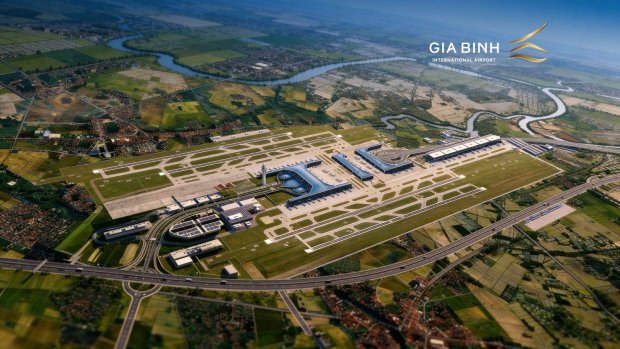 Credit: Masterise Aviation Infrastructure
Gia Binh International Airport (GBN), the new gateway for Hanoi and northern Vietnam: why it is being built, what it offers airlines and where the project stands today.
Vietnam is one of the world’s fastest-growing aviation markets, and its capital is getting a new gateway. Gia Binh International Airport (GBIA – ICAO VVGB, IATA GBN), in Bac Ninh province in the Hanoi Capital Region, is Vietnam’s next international airport: a national project designed to give northern Vietnam the capacity, connections and service standards to compete with Asia’s leading hubs.
Why Vietnam needs a new gateway
- A fast-growing market: Vietnam’s air travel reached a record 83.5 million passengers in 2025, and the economy grew by more than 8% in 2025.
- Tourism on the rise: Vietnam welcomed 21.2 million international visitors in 2025 and is targeting 45–50 million a year by 2030.
- Industry on the doorstep: the Hanoi – Bac Ninh – Hung Yen – Hai Phong corridor attracts around 42% of Vietnam’s foreign direct investment, with major electronics manufacturers driving business travel and high-value cargo.
- Demand waiting to be served: around 4 million passengers a year travel between Hanoi and Europe or the Americas with no direct flight.
A national project
- Vietnam’s National Assembly approved the project in December 2025, with total investment of about VND 196,000 billion (around US$7.5 billion).
- The Ministry of Public Security is the project owner, and Masterise Aviation Infrastructure (MAI), a member of Masterise Group, is the investor and developer.
- International partners include daa International, McKinsey & Company, SOM, NACO, Nikken Sekkei, Artelia and AAC.
Built for scale and quality
- Capacity: 30 million passengers and 1.6 million tonnes of cargo a year by 2030, rising to 50 million passengers and 2.5 million tonnes by 2050.
- Airfield: designed to ICAO Code 4F for the largest wide-body aircraft, with two runways, CAT III approaches and 70–80 movements an hour at full development.
- Five-star ambition: designed to Skytrax five-star standards, with architecture inspired by the Vietnamese “Heaven, Earth and Humanity” philosophy.
- A planned network: the detailed plan foresees 17 domestic routes at launch and around 69 international destinations by 2030, working alongside Noi Bai to expand capacity for the capital region.
- An airport city: logistics, free trade zone, industrial parks, MRO, catering and leisure around the airport.
Progress on site
Construction began in August 2025. The air traffic control tower structure is essentially complete, runway pavement works are under way and the VIP terminal roof is going up. On 24–25 November 2026, the airport carried out its first flight inspection of the DVOR/DME navigation system.
Connected to the capital
A new direct expressway will bring central Hanoi to about 30 minutes from the airport, with a 120-metre-wide corridor now under construction. High-speed rail and metro links to the airport are expected by 2029–2030.
Key dates
As things stand, the tentative key dates are: the airport officially opens on 31 May 2027, starting with the VIP terminal; the direct expressway to Hanoi opens at the end of October 2027; Vietnam hosts the APEC Leaders’ Week in November 2027; and the commercial passenger terminal follows as a separate phase.
An invitation to airlines
Our Air Service Development team works with airlines planning their future in northern Vietnam, offering route launch support, co-marketing, destination marketing with tourism partners and market insight. Airlines and partners are invited to contact [email protected].
Sources: Vietnam National Assembly Resolution 256/2025/QH15; National Statistics Office of Vietnam; Civil Aviation Authority of Vietnam; GBIA planning figures and corporate presentation (October 2026).