



Tourism no longer resets: resilience becomes the new competitive edge

A tourism crisis used to be measured in months of lost demand. Increasingly, the more revealing measure is how quickly travellers, airlines and destinations reconfigure around it.
The new Resilience in a World that Doesn't Reset study from Tourism Economics and TOURISE, developed with Oxford Economics, finds that the average recovery from 85 major tourism crises has fallen from around 24 months in the early 2000s to just 10-12 months today.
That apparent improvement masks a more profound structural change: disruption is no longer an interruption to tourism growth but part of the operating environment.
The implications extend well beyond destinations directly exposed to conflict.
The Middle East crisis demonstrates how quickly airspace restrictions, fuel inflation, longer routings and misinformation can redistribute demand across global networks. Yet the response is not simply contraction. Travellers are substituting destinations, shortening booking windows and becoming more price-sensitive.
IATA data reinforces the point: Middle Eastern airline demand collapsed by 46.6% in Apr-2026, but global demand outside the region still increased by 1.2%.
The next phase of tourism resilience will therefore be less about returning to normal than continuously adapting to a normal that keeps moving.
Summary
- Tourism crisis recovery times have shortened from about 24 months in the early 2000s to roughly 10–12 months today, based on analysis of 85 major events.
- Disruption is now a permanent operating condition for tourism and aviation networks rather than a temporary interruption to growth.
- Middle East airspace and conflict impacts rapidly reshaped global traffic flows, with Gulf hubs’ disruption redistributing demand rather than simply eliminating it.
- IATA data shows Middle Eastern carrier demand fell 46.6% in Apr-2026 while demand outside the region still grew, including a 15.3% rise in direct Europe–Asia traffic.
- Affordability and inflation (fuel price spikes, longer routings, thin airline margins) are highlighted as a major risk that can suppress demand via higher fares.
- Resilience is increasingly a competitive advantage driven by diversification of source markets, flexible connectivity, and fast, credible communications to counter misinformation.
The crisis that never arrives alone
A rumour about an earthquake can now damage tourism demand before the ground moves. A war can close an airspace hundreds of miles from a holiday destination. A fuel shock can make an otherwise safe journey economically unattractive. A cyber incident can undermine confidence without cancelling a single flight.
That is the defining characteristic of the tourism market in 2026: disruption has become interconnected.
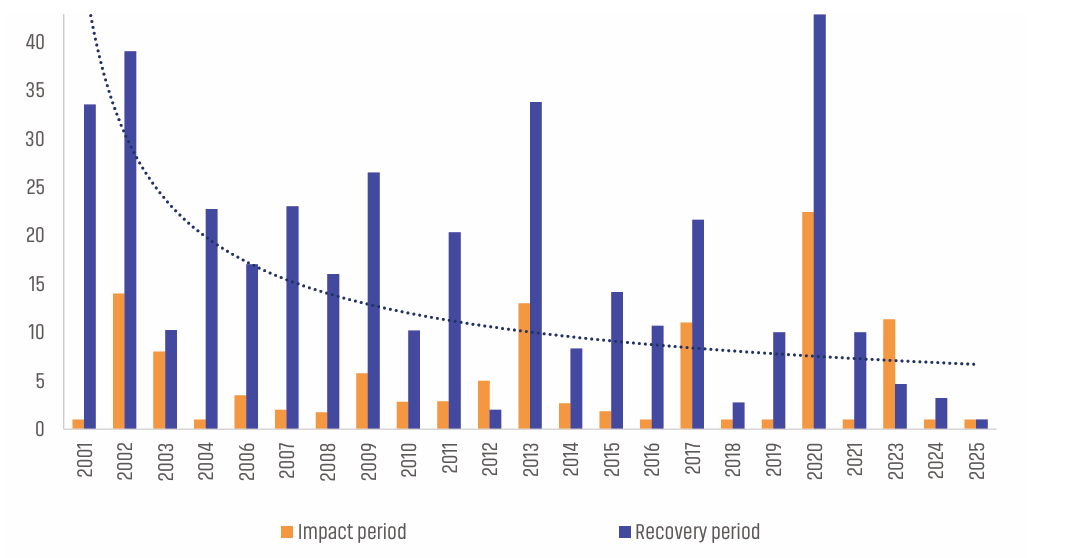
Tourism Economics and TOURISE's analysis of 85 major crises shows that average recovery times have fallen from approximately 24 months in the early 2000s to 10-12 months today.
Average crisis impact and recovery period over time, average number of months across destinations, by year (dashed line is trend line for recovery period)
Source: Resilience in a World that Doesn't Reset report.
The finding is striking because it runs counter to the impression of an increasingly fragile industry. In reality, it shows tourism has become substantially better at absorbing individual shocks.
Global international arrivals reached 1.52 billion in 2025, a record level and around 4% above 2024, despite a decade characterised by the pandemic, wars, climate events and geopolitical uncertainty.
The paradox is that faster recovery does not mean a more stable industry. It means an industry increasingly capable of moving around instability.
Recovery has become a network phenomenon
The old tourism model implicitly assumed that disruption happened to a destination. The contemporary model recognises that it happens to a network.
The Middle East provides the clearest example. Gulf hubs account for roughly 14% of global transit traffic and around one-fifth of normal Europe-Asia travel connects through the region. A disruption in Dubai, Doha or Abu Dhabi therefore does not simply suppress Gulf tourism. It changes the geography of global aviation.
IATA's data captures the mechanism. Its Apr-2026 data highlights this strongest as global passenger demand fell 3.4% year on year, while international demand declined 5.3%. Yet excluding the Middle East, international demand increased 1.9%.
Middle Eastern carriers recorded a 46.6% fall in demand, with capacity down 37.2%. At the same time, European carriers saw direct Europe-Asia traffic increase by 15.3% as passengers and airlines bypassed Gulf hubs.
That is not global tourism collapse. It is simply network substitution.
The wrong question is whether people still travel
Much of the industry's crisis planning remains anchored around a binary question: will consumers travel or not? The evidence increasingly says that this is the wrong variable.
When uncertainty rises, travellers do not necessarily abandon travel. They alter its composition. They move closer to home, select destinations perceived as safer or better value, reduce the time between booking and departure, and become more willing to change plans.
A hypothetical 2% fall in global international trips could therefore conceal a much larger redistribution of spending. One destination might lose 15% of its long-haul arrivals while a neighbouring market gains 10%. An airline exposed to one disrupted corridor can suffer sharply even while its competitors elsewhere experience unusually strong demand.
This is why the Tourism Economics scenarios are revealing. If the Middle East ceasefire holds, global travel is modelled to grow around 6% in 2026. A resumption of hostilities reduces travel by about 1%, while sustained disruption produces a roughly 3% decline and weakness extending into 2027.
The range is relatively narrow at the global level, but potentially enormous at the market level.
Affordability is the more dangerous shock
The industry's fixation on security risks overlooking the less visible threat: price. A traveller can tolerate a changed itinerary. They are less able to tolerate a 20% increase in the cost of reaching it.
The Tourism Economics analysis points towards a renewed inflationary shock, with a prolonged conflict scenario potentially pushing global inflation towards 8%. Higher fuel prices, longer flight paths and reduced operational efficiency would then feed into airfares, accommodation and other tourism costs.
IATA's evidence already shows the transmission mechanism. Looking at that Apr-2026 data again, IATA reported that jet fuel prices had more than doubled year on year, while global passenger demand contracted.
By May-2026, global demand remained 2.2% below the previous year, although the rate of decline in Middle Eastern traffic had improved substantially. IATA also warned that airlines operating on margins of only around 2% would have little choice but to test the resilience of demand through higher fares.
The industry's greatest vulnerability may therefore not be that people become unwilling to travel. It is that they become unwilling to pay the marginal cost of travelling.
Confidence now moves faster than capacity
Physical disruption remains visible. Sentiment disruption is not. The report's example of viral megaquake rumours in 2025 is particularly instructive: bookings from some East Asian source markets fell by as much as 50% despite there being no scientific basis for the claims.
That changes the economics of destination management. Airlines and airports can monitor cancelled flights. Destination authorities are much less equipped to monitor a narrative spreading through social media at 3am.
The information environment has effectively become another piece of tourism infrastructure.
This matters because confidence can deteriorate before capacity does.
A destination may have functioning airports, open hotels and no physical security issue, yet still experience a sudden demand shock. Recovery then depends not simply on reopening infrastructure but on restoring credibility.
Tourism is learning to route around the shock
The most consequential finding in the study is not that tourism recovers faster. It is that tourism has become more geographically diversified.
The ten largest source markets accounted for 54% of global travel in 2001 but only 45% in 2025. Meanwhile, the number of source markets required to generate half of international travel increased from eight to 14.
That is a profound structural change. Demand is less concentrated, giving the global system more points through which growth can continue when one market weakens.
The same principle applies to aviation networks. As previously noted, IATA recorded a 15.3% increase in direct Europe-Asia traffic in Apr-2026 as airlines and passengers substituted for disrupted Middle Eastern connections. Asia-Pacific airline demand itself increased 3.0% that month, while Latin American carriers recorded 8.9% growth.
The result is an industry that increasingly behaves like a fluid network rather than a collection of national tourism markets.
Resilience is becoming a commercial asset
This is where the Tourism Economics research becomes more than a crisis-management study. Destinations that prepare before disruption recover up to 1.5 times faster than those that wait, it identifies. Preparation therefore has an economic return.
Diversified source markets reduce exposure to individual shocks. Flexible air connectivity creates alternative routes. Strong domestic and regional demand provides a buffer when long-haul markets retreat. Clear communications protect confidence. Financial capacity gives operators time to absorb temporary losses rather than cutting capacity at precisely the wrong moment.
Saudi Arabia provides an unusually explicit example. The country recorded 37.2 million tourists in the first quarter of 2026, an 8% year-on-year increase, and reached its 100 million annual visitor target seven years earlier than planned.
The lesson is not that every destination should replicate Saudi Arabia. It is that diversification, connectivity and investment can materially change how an economy absorbs volatility.
The next competitive divide will be adaptability
The tourism industry has spent decades optimising for efficiency: fuller aircraft, higher hotel occupancy, concentrated distribution, tightly managed inventories and increasingly sophisticated yield management.
The next decade will demand a different optimisation problem. Efficiency maximises returns when conditions are predictable. Resilience maximises the ability to preserve returns when they are not.
This creates an uncomfortable trade-off. Holding spare capacity costs money. Maintaining multiple source markets can dilute marketing efficiency. Alternative air routes may be less profitable. Flexible cancellation policies shift risk towards suppliers. Redundant systems and crisis teams add cost when nothing goes wrong.
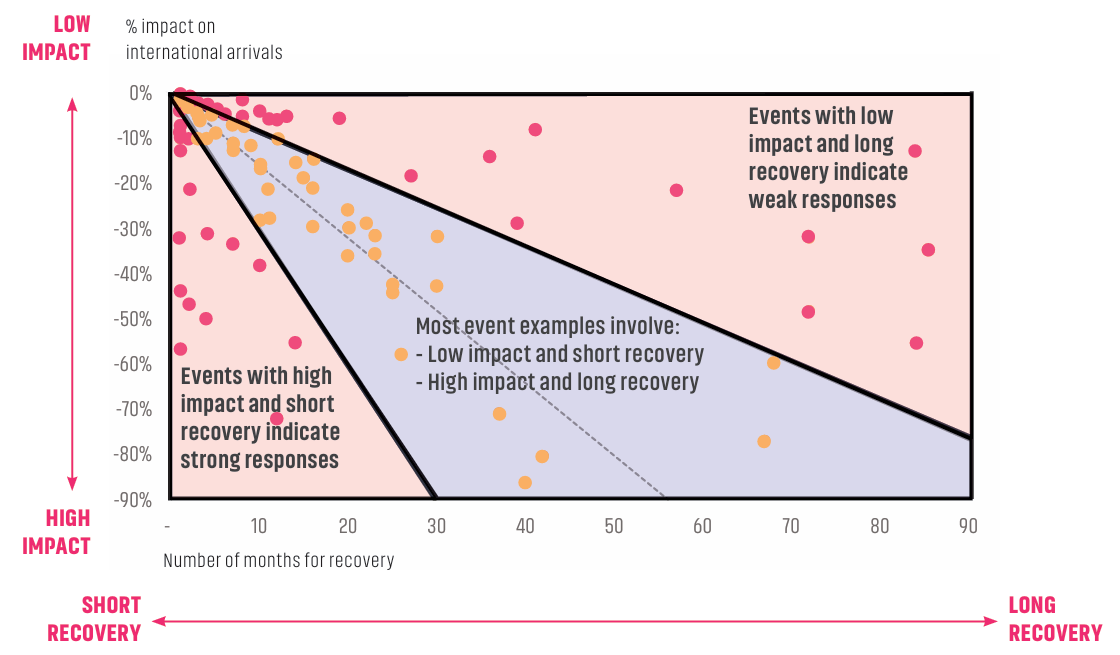
Crisis impact vs recovery duration, by event
Source: Resilience in a World that Doesn't Reset report.
But the economics of disruption are changing. If the average crisis now lasts 10-12 months rather than 24, the cost of being unable to respond quickly can exceed the cost of preparedness.
Conversely, an organisation that can redirect capacity, pricing and marketing within weeks rather than quarters can capture demand displaced from competitors.
The Middle East crisis has already demonstrated this. IATA's data shows that while Middle Eastern carriers were severely damaged, other networks absorbed part of the displaced demand.
The tourism business is therefore moving towards a model in which the winners are not necessarily those with the strongest growth forecasts, but those capable of changing direction fastest when those forecasts become obsolete.
The new normal is not instability. It is constant reallocation.
Tourism's apparent resilience should not be mistaken for immunity. The 1% global decline projected under a renewed Middle East conflict scenario sounds remarkably benign until the analysis is viewed through an airline, airport or destination rather than a global aggregate.
A 1% change in global travel can produce a 10-20% shock on an individual route. A 5% increase in fares can be absorbed by affluent long-haul travellers but become prohibitive for price-sensitive families. A disrupted Gulf connection can simultaneously weaken one hub while creating unexpected growth for direct Europe-Asia services.
That is why CAPA - Centre for Aviation sees the principal structural shift not as a more resilient tourism industry, but as a more fluid one.
The industry is becoming better at absorbing shocks because travellers have more choices, airlines can redeploy capacity, networks can be reconfigured and source-market concentration has declined. But those mechanisms do not eliminate the economic consequences. They redistribute them.
For airlines, airports and destinations, resilience will increasingly be visible in commercial metrics: the speed with which capacity can be redeployed, the breadth of the source-market portfolio, the ability to protect yields without destroying demand, and the credibility of communications when confidence deteriorates.
The next crisis will therefore be judged less by how much tourism disappears than by where it goes instead. And by 2030, the fastest-growing travel markets are likely to be those already designed to capture demand that someone else's crisis has displaced.