



Vietnam’s ultra expensive Long Thanh Airport nears end-2026 opening date but there are problems

The absence of the private sector at Vietnam's airports has eased in recent years and several airports now have private firms involved in their expansion, or in new greenfield ones, usually through PPP arrangements.
There is no such involvement yet at Long Thanh, the new greenfield airport, possibly the world's most expensive, which is being built near Ho Chi Minh City, the country's most populous and commercial centre, which is set to open at the end of 2026 and which will eventually succeed the existing Tan Son Nhat Airport there as Vietnam's principal gateway.
However, numerous foreign investors, led by the UK's Export Finance Department, are keen to help with the financing of associated surface transport and other infrastructure there by guaranteeing loans.
That sends a signal to investors that even though the Vietnamese government has outsourced the funding and construction of the new airport to Airports Corporation of Vietnam (ACV) a door might open for them (the UK Export Finance Dept can and does guarantee loans for airports).
ACV is not actively seeking such an investor but a succession of difficulties at Long Thanh, including allegations of corruption, might suggest that luring one in would at least put a shine on it; assuming that is, that investors would want to take the risk anyway.
Summary
- One of the world’s most expensive greenfield airports, Long Thanh in Vietnam, is set to open Phase 1 by the end of 2026. It will eventually have the capacity to handle over 100mppa and to challenge regional rivals for hegemony. Passenger fees have been set and they are on the low side regionally
- Tourism authorities are now tasked with turning arriving passengers at Ho Chi Minh City into high-value paying visitors; tourism accounts for 10% of Vietnam’s GDP and Ho Chi Minh City has witnessed a remarkable 50% hike in international tourist arrivals
- But not all is sweetness and light - the Long Thanh project does face several challenges; the airlines are cautious about making the switch from the existing Tan Son Nhat Airport, surface transport is a potential bottleneck and critically there are allegations of corruption involving some of the main players
- Domestic and international investors are keen to be involved in surrounding infrastructure projects including energy ones and there may be opportunities to combine transport and energy. A new International Financial Centre will help to channel funds into transportation infrastructure
- But the acid test is whether an investor can be found for Long Thanh whether or not the government even wants one; that would change the parameters of the project but such investors may be hard to attract in the light of the current issues.
One of the world's most expensive greenfield airports is set to open Phase 1 by the end of 2026
The most expensive airport currently under construction in the Asia Pacific region, possibly in the world as estimated costs vary, is Vietnam's Long Thanh International Airport (LTIA), with a total estimated investment cost across its development cycle of USD16 billion.
It is the most expensive construction project in the country's history and is being funded and built by Airports Corporation of Vietnam (ACV), the state-backed enterprise, using its own corporate capital and accumulated cash reserves and supported by domestic commercial bank loans and state allocations from institutions like Vietcombank, VietinBank, and BIDV.
Its actual construction is led by Turkish company IC Ictas, as part of a consortium.
There is no private partner as yet although the government would surely welcome one or more, in commercial and service opportunities around the airport estate if not in the airport infrastructure itself.
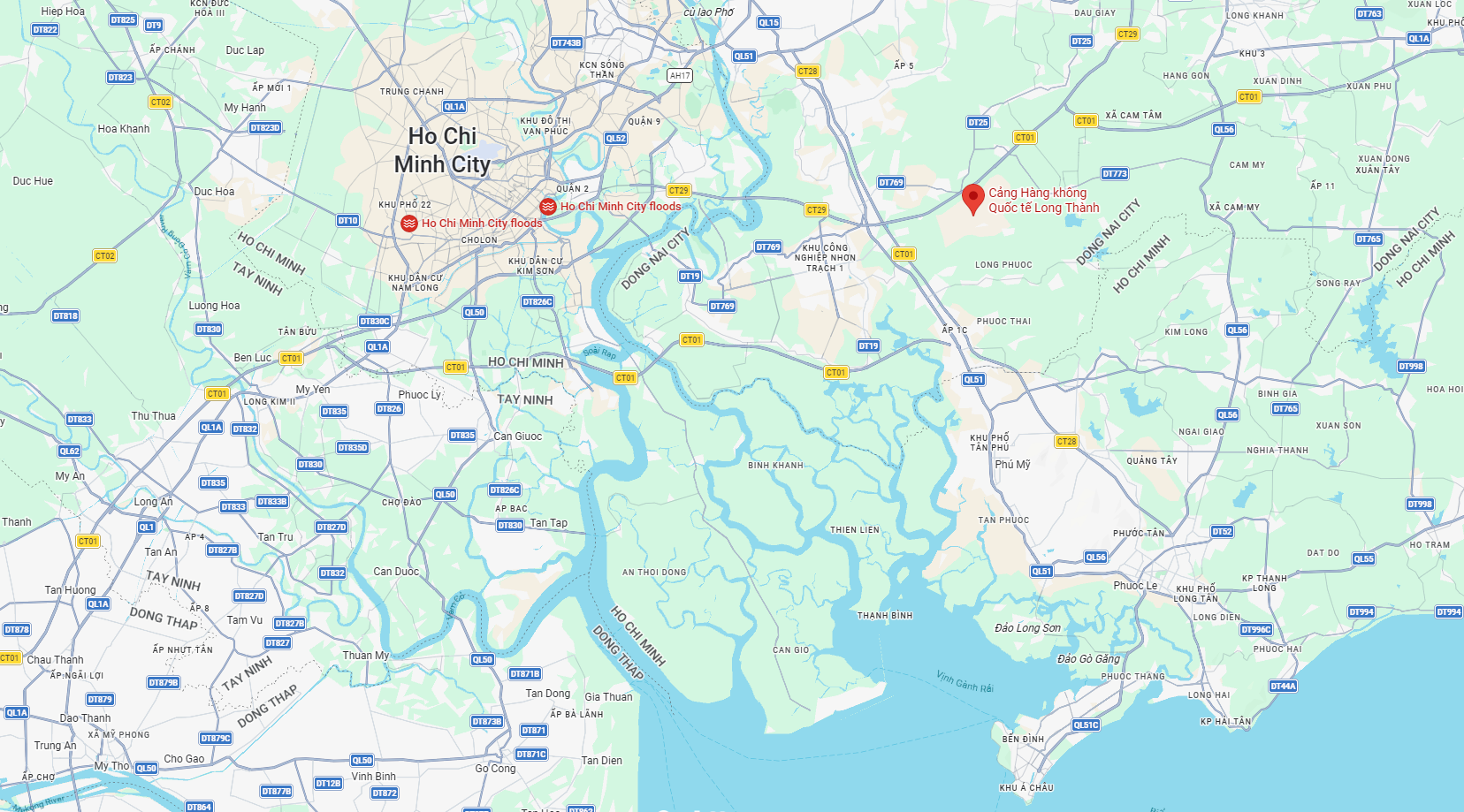
LTIA is situated in Dong Nai Province, approximately 40 km (25 miles) east of Ho Chi Minh City. Vietnam.
Location of Long Thanh International Airport relative to Ho Chi Minh City
Source: Google Maps.
It will eventually have the capacity to handle over 100mppa and to challenge regional rivals for hegemony
Designed eventually to handle over 100 million passengers, presenting a future challenge to regional rivals, and five million tonnes of cargo annually, upon final completion it will be not only initially a reliever airport for Tan Son Nhat International Airport in Ho Chi Minh City, the most populated in the country with over 10.5 million people and the main business and financial hub, but also a future primary mega-hub designed to absorb the majority of international passenger and cargo traffic.
Long term plans involve shifting long-haul international flights and the majority of international traffic to LTIA, while Tan Son Nhat Airport will continue handling domestic flights and shorter regional routes.
Following initial technical tests, commercial operations are presently slated to begin in late 2026, following a technical opening in Dec-2025, with international traffic from Tan Son Nhat Airport shifting in stages, running through Mar-2027 at first and then in late 2027.
Passenger fees have been set and they are on the low side regionally
At the end of Sep-2026 the Ministry of Construction made its decision setting the service fees for passengers at LTIA, effective 01-Oct-2026, so that department must be confident that the construction is proceeding on time.
And those fees were at the lower end of the scale for the region, with domestic flight fees set at VND90,909 (USD3.50) per passenger; and for international flights at USD25 per passenger.
Passenger service fees in Southeast Asia average roughly USD3 to USD8 for domestic flights and USD25 to USD36 for international departures.
As things stand, LTIA's fees would be lower than at many of Thailand's major airports but higher than those in Malaysia.
It is anticipated locally that LTIA will transform Vietnam's economy and travel sector by serving as a critical regional aviation and logistics mega-hub.
Major carriers like Vietnam Airlines and VietJet Air will shift key international routes to Long Thanh, connecting southern Vietnam directly to major hubs across Asia, Europe, and beyond.
Apart from growing passenger numbers over and above what Tan Son Nhat can achieve, Phase 1 will enable the handling of 1.2 million tons of cargo annually, speeding up exports and international trade.
Modern smart airport technologies will be employed from the get-go, along with spacious facilities to reduce arrival bottlenecks.
The surrounding transport network-including new expressways, ring roads, and proposed free-trade zones in Dong Nai-creates a multimodal export ecosystem.
New express bus networks and electric transit options will connect the airport to Ho Chi Minh City and nearby destinations.
Tourism authorities are tasked with turning arriving passengers into high-value paying visitors; tourism accounts for 10% of Vietnam's GDP
As for tourism, regional tourism boards are actively developing specialised local products and promotional campaigns to turn the airport's high visitor volume into extended stays in Dong Nai and the southern economic region.
Tourism is an important part of the marketing mix where LTIA will be concerned. It is a vital and rapidly growing pillar of Vietnam's economy, contributing nearly 10% of the country's GDP and acting as a primary driver of modern economic growth.
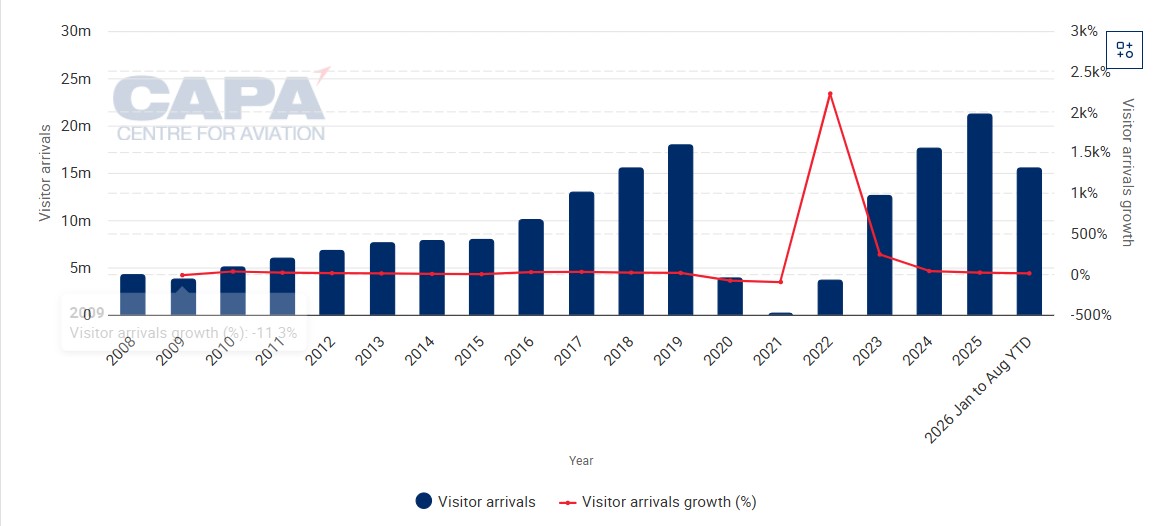
Tourism growth was consistent in the decade from 2009 to 2019, then destroyed by the COVID-19 pandemic, but rebounded rapidly. Vietnam welcomed a record breaking 21.2 million international visitors in 2025 (+17.5% over 2019) and momentum continued into 2026 with 15.5 million arrivals recorded in the first eight months alone.
Vietnam annual tourism: annual arrivals, 2008 - 8M2026
Source: CAPA - Centre for Aviation and General Statistics Office of Vietnam.
Vietnam has outpaced several traditional Southeast Asian neighbours, ranking high in international tourism growth rates and capturing large shares of travellers from key markets like South Korea, China, and Europe where rival countries like Thailand have struggled, visitor numbers there declining by over 7% between 2024 and 2025 and by a further 4.3% in the first eight months of 2026.
Vietnamese policymakers and industry leaders are shifting their focus from sheer visitor volume to high-value tourism, targeting longer stays, higher daily spending, and luxury or eco-conscious experiences.
Ho Chi Minh City sees a remarkable 50% hike in international tourist arrivals
Ho Chi Minh City itself posted a remarkable close to 50% year-on-year surge in international tourist arrivals in 1H2026 (although domestic visitor numbers declined by 5%), with travel revenues jumping as high-spending tourists flocked to its premium culinary and nightlife scenes.
Tourism revenue has jumped by 43.4% in the first nine months of 2026, reaching approximately VND282.7 trillion (USD10.7 billion) due to higher spending and longer stays by foreign guests.
Foreign visitors are facilitated by favourable government policies such as expanded open-visa frameworks (e.g. 45-day visa waivers for select European countries) and upgraded aviation and resort infrastructure, which collectively continue to cement the country's status as a premier global destination.
But not all is sweetness and light
The Long Thanh project does, though, face several challenges.
Disputes over fees and airlines' reluctance to move flights from Tan Son Nhat figure highly as one challenge.
Already the project has been repeatedly delayed by graft investigations (a form of political corruption or bribery where a person in power dishonestly uses their public position or influence to acquire money or personal advantages), also labour shortages and rising costs. A single corruption investigation resulted in 31 prosecutions. Those charged with bribery, bid-rigging or other offenses included officials at ACV - including its Chairman and a Board member - and at member firms in the construction consortium.
Such form is not attractive to airline users and ACV, which oversees most of Vietnam's airports, has acknowledged that the criminal case had damaged its image while pledging continuing cooperation with authorities.
Airlines cautious about making the switch from Tan Son Nhat
With commercial operations now targeted for Dec-2026, attention is shifting from construction to the challenge of attracting airlines and passengers from Ho Chi Minh City to the neighbouring Dong Nai province.
Airlines have been cautious about shifting flights to LTIA, with concerns over fees emerging as an early test of how quickly carriers are willing to embrace the new airport.
Despite those concerns, ACV is reported to be considering 21 more international routes for LTIA that are not currently served by the Tan Son Nhat airport, including destinations in China, India, Europe and the US.
But attracting carriers to the new gateway is proving to be as challenging as completing the construction has been. Construction was at first intended to commence in 2014 and has been slow since, and while it has speeded up, certain secondary projects - such as cargo terminals, maintenance hangars, and catering services - are still behind schedule.
Airlines have requested financial incentives, including reducing Long Thanh's international passenger service charge to USD20 from the proposed USD25, thereby matching fees at Tan Son Nhat. The carriers argue that higher charges could make ticket sales more difficult at a time when demand remains uncertain and airlines are still recovering from recent geopolitically inspired industry disruptions in other regions as well as localised ones caused by seasonal weather events, volcanic eruptions and drone activity.
To encourage the transition, ACV has offered a generic 50% reduction in landing and take-off fees for the airport's first 24 months of operation. The government also suspended some aviation-related charges, including an environmental tax on jet fuel, as airlines grappled with fuel supply disruptions following the US-Israeli attacks on Iran and the aftermath.
The government's transition plan calls for international flights to move from Tan Son Nhat to Long Thanh in three stages. Airlines are expected to begin the initial shift between Dec-2026 and Mar-2027, with all long-haul international flights moving by Oct-2027 and most remaining international services by Mar- 2028. LTIA's first phase is designed to handle 25 million passengers and 1.2 million tons of cargo annually.
Surface transport is a potential bottleneck
Beyond these airline concerns, surface transport links are another potential bottleneck. Numerous road projects connecting Dong Nai province with Ho Chi Minh City have fallen behind schedule, raising concerns about accessibility during the airport's first phase of operations.
It seems that the earliest gains will most likely be seen in sectors such as ground transportation, retail and accommodation, while broader air transport benefits, including new international routes and a restructuring of regional logistics networks, will emerge more gradually.
At least the authorities have recognised that preparing the ecosystem in which the airport operates must begin long before it reaches capacity.
Domestic and international investors keen to be involved in surrounding infrastructure projects
Putting the corruption allegations aside, if there is one way in which Vietnam is benefitting from the project it is in the fact that both domestic and international private investors have signalled strong interest in surrounding infrastructure projects linked to the airport.
They include proposed railway lines and transport links connecting LTIA to Ho Chi Minh City under public-private partnership (PPP) models.
For example, UK Export Finance (UKEF), Britain's export credit agency, is planning up to USD2.5 billion in financing to help Ho Chi Minh City extend its metro line to LTIA. The metro package would support a 44 km extension connecting the city, the airport and central Dong Nai.
The funds are expected to include loans, guarantees and other financial support rather than direct investment and form part of a broader USD6.5 billion UKEF credit framework for Vietnam, formalised by way of an agreement that was signed during President Tô Lâm's visit to the UK in 2025.
The package reflects growing foreign interest in Vietnam's infrastructure sector as the country embarks on a series of transport, energy and logistics projects worth tens of billions of dollars.
The UKEF's country head for Vietnam, Cambodia and Laos said recently that it is ready to support "the big [infrastructure] agenda" of the country, adding that the metro project would include UK technology and services, in line with UKEF requirements that at least 20% of project content be sourced from the UK.
Rapid transit is increasingly seen as critical for southern Vietnam as transport infrastructure struggles to keep pace with rising economic activity. Driving between Tan Son Nhat airport and Long Thanh can currently take about two hours.
The broader UKEF package also includes EUR150 million (USD173 million) in proposed financing to procure additional rolling stock for Ho Chi Minh City's first metro line, which opened in late 2024. Strong ridership has created demand for more trains.
The route would extend beyond LTIA to central Dong Nai, forming one part of a three-part corridor that city officials plan to build, including another metro line and the national high-speed railway.
Energy projects are also on investors' minds
And the broader UKEF package is also expected to support energy projects. Vietnam's Ministry of Industry and Trade has said it would focus on wind power, smart grids and other areas under the Just Energy Transition Partnership (JETP), launched by wealthy nations to help developing economies reduce their dependence on coal.
As CAPA - Centre for Aviation has often, and recently, pointed out the typical airport estate has been expanding for many years now to incorporate energy related projects; those that create energy such as solar panel arrays and latterly those that use it, such as information technology related buildings including data centres.
These activities can and will be incorporated into new airports and there is no reason why that should not happen at LTIA.
The UKEF representative spoke at a British government-sponsored business forum in Ho Chi Minh City, where local officials highlighted the importance of attracting international capital to support the city's development plans.
International Financial Centre will help to channel funds into transportation infrastructure
The vice chair of the Ho Chi Minh City People's Committee said the Vietnam International Financial Centre, which opened its doors in Dec-2025, will help with channelling funding into transportation infrastructure, energy efficiency, green manufacturing and climate-adaptation projects.
For Vietnam, securing such financing is becoming increasingly important as the government accelerates one of the region's largest infrastructure build outs. The country is pursuing a growing list of capital-intensive projects, including the Long Thanh airport, urban rail systems, expressways, ports, power networks and a proposed high-speed railway linking Hanoi and Ho Chi Minh City.
As a manufacturing powerhouse targeting 10% economic growth in 2026, Vietnam faces mounting pressure to expand transportation and energy capacity. Authorities recently launched dozens of infrastructure projects worth tens of billions of dollars, underscoring both the scale of investment required and the increasingly important role foreign-backed financing may play in meeting those ambitions.
But the acid test is whether an investor can be found for Long Thanh; that would change the parameters of the project even if the government isn't seeking one
But where the airport sector is concerned Vietnam suffered for years from the collapse of a deal in 2018 which would have seen France's Groupe ADP sign an agreement intended to lead to ADP acquiring a 20% equity stake in ACV, aiming to become its strategic investor.
However, that was eight years ago, time is a great healer and more recently there are several regional airports that are benefitting from PPP agreements or which may do in the foreseeable future including Quang Tri and Phan Thiet airports which are already using private funding through PPP and commercial investment models.
More detail on these deals can be found in the Jul-2026 CAPA - Centre for Aviation report: 'Vietnam's airports to grow by seven by 2030 - private capital still greatly needed'.
There are numerous impediments still to private investment as indicated in that earlier report and the government would be helped enormously if it could find an investor to commit to the Long Thanh project as a whole, above and beyond the existing peripheral deals and even though it has signed the project over to ACV.
Finding and securing one or more would send out a far greater message to the world that Vietnam is open for business.
But that cannot happen unless and until the government, which has historically prioritised state-led development for this flagship infrastructure, relents.
As such, ACV acts as the primary investor and operator for this mega-project, limiting opportunities for private stakeholders.